Pharmagen: Artificial Intelligence and Personalized Medicine
NGS pipeline design and pharmacogenomic prediction models via Deep Learning
The Problem: The “Standard Dosing” Fallacy
Traditional medicine often relies on one-size-fits-all population statistics, assuming Gaussian metabolism curves that ignore extreme phenotypes such as poor or ultrarapid metabolizers. For narrow therapeutic index drugs like acenocoumarol or 5-Fluorouracil (5-FU), this lack of personalization leads to therapeutic failures or lethal toxicities.
Pharmagen was created to close this gap, integrating a complete workflow from raw genomic data to clinical prediction.
Project status
Pharmagen is moving from a research prototype to maintainable, deployable software. Two fronts run in parallel:
- v1 — research prototype (complete). A hybrid DeepFM + Transformer network trained on ClinPGx and dbSNP. It validated the hypothesis and defined the problem. A later self-audit found data-handling and train/test-split assumptions that likely introduced information leakage and made the early metrics optimistic — so I treat them as preliminary and do not use them as final results.
- v2 — in progress. Two concurrent tracks: (1) scientific, migration to a Two-Tower GATv2 graph architecture (PyTorch Geometric); (2) engineering, a full refactor to industry standards (Pydantic v2 at every boundary, a FastAPI service, CI with ruff + pytest,
uv-managed dependencies) plus a rigorous, leakage-aware evaluation protocol (clean splits, an explicit baseline, honest balanced metrics).
The v1 prototype proved the idea works; v2 is about making it robust, reproducible, and rigorously evaluated.
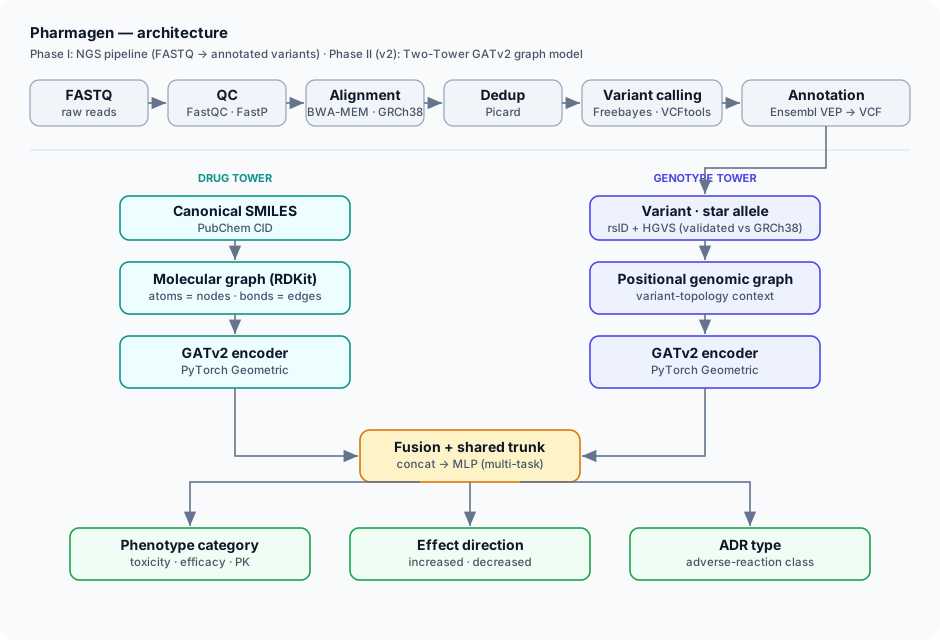
Phase I: Orchestrated Bioinformatics Pipeline
I designed a modular bioinformatics pipeline orchestrated in Python 3.10 on Debian 13 (Trixie). The system automates the processing of massive reads (NGS), ensuring reproducibility through the uv environment manager.
Workflow (Phase I):
- Quality Control:
FastQCandFastPfor low-quality read filtering and adapter trimming. - Alignment: Mapping against the GRCh38 reference genome using
BWA-MEM. - BAM Processing: PCR duplicate identification with
Picard (MarkDuplicates)to prevent allelic bias. - Variant Calling: Haplotype-based SNP and Indel extraction with
Freebayesand strict filtering viaVCFtools. - Functional Annotation:
Ensembl VEPin offline mode to determine the transcriptional impact of each variant.
Phase II: DeepFM Architecture and Multi-Task Learning
For clinical inference, I developed a hybrid neural network architecture trained on curated data from ClinPGx and dbSNP.
Critical Feature Engineering Decisions:
- Pure Chemical Identifiers: Replaced ATC classification with PubChem CID. Models need to represent real physicochemical interactions, not abstract therapeutic categories.
- “Genalle” Variable: A synthetic identifier fusing the rsID with HGVS notation, enabling strict allelic normalization.
- Imbalance Management: Implementation of Adaptive Focal Loss and Asymmetric Loss to penalize errors in rare but critical adverse effects, prioritizing patient safety.
The Mathematical Model
The architecture combines Factorization Machines (FM) for second-order interactions and a Transformer Encoder with Self-Attention mechanisms to capture complex phenomena such as epistasis.
\[\hat{y} = \sigma \left( w_0 + \sum_{i=1}^n w_i x_i + \sum_{i=1}^n \sum_{j=i+1}^n \langle v_i, v_j \rangle x_i x_j + y_{DNN} \right)\]
Results and an honest methodological note
v1 was tuned with Optuna (40 studies) and 5-fold cross-validation, and on the internal splits the network learned the multi-label task consistently — a valid proof of concept that the gene–drug signal is learnable with this representation.
On closer review, however, I found assumptions in data preparation and splitting (in the allelic normalization and the train/test separation) that likely leaked information across sets and inflated the metrics. That is why I do not publish those numbers as a result: presenting them as final would be misleading.
What v1 does establish is solid: the representation choices (PubChem CID over ATC, the Genalle identifier) and the imbalance-aware losses work. v2 rebuilds the evaluation from scratch with leakage-free splits, an explicit baseline, and balanced metrics reported alongside the methodology that produced them. Once those figures are validated, they will be published here with their protocol.
The Clinical “Red Light”
The system integrates a binary therapeutic success/failure variable. For instance, given a combination of Toxicity + Increased + Risk, it automatically assigns a therapeutic failure, functioning as a Clinical Decision Support System (CDSS). It is an interpretation layer, not a medical device.
v2: Graphs and industry standards
Scientific front. Migration to a Two-Tower GATv2 architecture with PyTorch Geometric: drugs are represented as molecular graphs (atoms as nodes, bonds as edges, built with RDKit) and the genome as contextual positional graphs, natively capturing the biological topology that tabular embeddings cannot process.
Engineering front. A full refactor to the standards v1 lacked: Pydantic v2 typing every data boundary, a FastAPI inference service (OpenAPI, health/readiness probes), CI (ruff + pytest, ~240 unit tests), reproducible dependencies with uv, and the leakage-aware evaluation protocol above. The goal: turn a working experiment into software others can build on.
Detailed Tech Stack
- Language: Python 3.14 (managed with
uv), Bash. - Deep Learning: PyTorch, PyTorch Geometric (GATv2), Optuna, AdamW, GELU.
- Cheminformatics: RDKit (SMILES → molecular graphs).
- Engineering: Pydantic v2, FastAPI, pytest, ruff, CI (GitHub Actions).
- Bioinformatics: BWA-MEM, Picard, Freebayes, VCFtools, Ensembl VEP.
- Infrastructure: Debian 13 (Trixie), NVIDIA RTX 4070 Ti Super (16 GB VRAM).